
Local SEO in Dubai: How to Rank on Google Maps Search
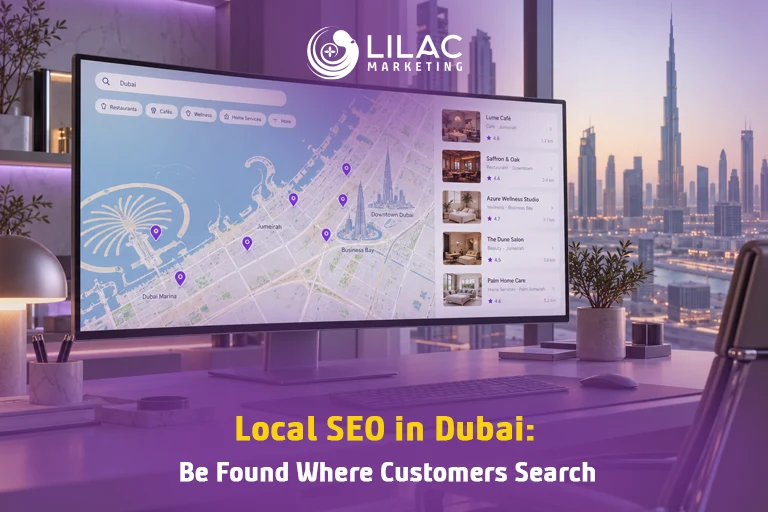
A search for “dentist near me,” “AC repair Business Bay,” or “accounting firm in DIFC” usually signals an immediate need. Local SEO in Dubai work earns visibility in Google Maps, the local pack, and location-focused organic results, then helps the searcher call, book, visit, or request directions.
Dubai is not one local market. Results change with location, query, category, and nearby competition. A clinic in Dubai Marina faces a different search environment from one in Deira; a mobile maintenance company follows different address rules from a showroom.
This guide follows current Google documentation and Dubai-specific examples. It covers Business Profile setup, keywords, citations, location pages, reviews, structured data, mobile experience, and tracking without presenting unconfirmed tactics as ranking factors.
Introduction: Why Local SEO Matters for Dubai Businesses
Local SEO improves visibility for searches tied to a place or nearby need. It affects Google Maps, the local pack, and organic results with local intent.
A Google Business Profile can display:
- Opening hours.
- Contact information.
- Directions.
- Services.
- Photos.
- Reviews.
- Category-dependent actions.
Accuracy is commercially important. A wrong pin, outdated Eid hours, or a phone number that reaches the wrong branch can lose a customer even when the business ranks well.
Local SEO is therefore also location-data management and customer experience.
It also complements paid acquisition. Google Ads in Dubai can create immediate search visibility, while Maps and organic local results provide non-paid discovery and additional comparison information. Lilac’s wider SEO & GEO strategy connects those channels around sustainable search visibility.
How Local SEO Works: The Google Maps Algorithm
Google does not disclose its full local ranking system, and no agency can guarantee a permanent number-one Maps position.
Google’s official local ranking guidance identifies three primary factors: relevance, distance, and prominence.¹ Their influence varies depending on the query and searcher.
Relevance, Distance, and Prominence
Relevance is how well the business matches what someone is searching for.
Accurate categories, services, profile details, and website content help Google understand that fit. Choose the closest primary category, then add only genuine secondary categories.
Distance reflects how far the business is from the location used in the search.
If the searcher does not specify a location, Google estimates it from the location information available. Keywords cannot erase distance, and adding large service areas does not create equal Maps visibility throughout Dubai.
Prominence reflects how well known or established a business appears.
Google specifically refers to signals such as links, reviews, and information available across the web. Review count and positive ratings can also contribute to local ranking.¹
Local Search Ranking Factors for 2026
There is no separate published “2026 formula.”
The practical priorities are:
- Eligibility and compliance: Use a genuine eligible location or correctly configured service-area profile.
- Category accuracy: Select categories that genuinely describe the business.
- Profile completeness: Keep address, pin, phone, hours, website, services, and attributes current.
- Local relevance: Create useful information for areas genuinely served.
- Prominence: Earn genuine reviews, relevant links, credible mentions, and reputable listings.
- Website quality: Keep important pages crawlable, useful, mobile-friendly, and technically sound.
- Conversion readiness: Make calls, bookings, forms, and directions easy to complete.
Google explicitly states that businesses cannot request or pay for better organic local rankings.¹
Google Business Profile: Complete Optimization Guide
Step 1: Claim and Verify Your Profile
Search for the business name in Google Search and Maps before creating anything.
If a profile already exists, request access rather than creating a duplicate.
Google’s Business Profile guidelines require businesses to represent themselves as they appear in the real world, including their real name, location, and core business category.²
Use the real-world name shown on:
- Signage.
- Website.
- Licenses.
- Customer-facing materials.
Do not append services, neighborhoods, or keywords simply to target search queries.
Google determines which verification methods are available for each profile. Depending on the business, methods may include video, phone, email, live video, or mail.
Set the business type correctly:
- Storefront: Customers visit the location during stated hours.
- Service-area business: The business travels to customers and should normally hide an address where customers are not served.
- Hybrid business: Customers can visit a legitimate staffed location, while the company also travels to customers.
Google does not allow an unstaffed virtual office to function as a service-area storefront.²
Step 2: Complete Every Section
Treat the profile as live location data rather than a listing created once and forgotten.
Review each field:
- Business name: Use the genuine public-facing name.
- Primary category: Select the closest category describing the core business.
- Secondary categories: Add only categories representing real services.
- Address and pin: Keep both accurate.
- Service area: Use genuine areas the business actually serves.
- Phone: Prefer a direct location number where possible.
- Website: Link to the most relevant branch or location page.
- Hours: Maintain regular and special hours.
- Description: Explain the offer and useful differentiators naturally.
- Services and products: Add accurate information that customers can rely on.
- Attributes: Maintain relevant customer-facing attributes.
Google’s guidelines specifically discourage using categories merely as keywords and require accurate real-world representation.²
Step 3: Add Photos and Videos
Use media to answer practical questions.
Show:
- Entrance and signage.
- Interior.
- Team.
- Products.
- Services.
- Parking or access.
- Equipment.
- Completed work where appropriate.
Service-area businesses can show teams, vehicles, tools, and real project environments.
Keep media authentic and current.
Google encourages businesses to add photos and videos but does not describe photo quantity or posting frequency as a standalone ranking shortcut.¹
Step 4: Manage Reviews Strategically
Google states that more reviews and positive ratings can contribute to prominence.¹
Request feedback after genuine transactions through a neutral process.
Do:
- Invite honest feedback.
- Use the official review link.
- Use a QR code where appropriate.
- Contact customers through a normal post-service channel.
- Send multi-location customers to the correct branch.
Do not:
- Pay for reviews.
- Offer discounts in exchange for reviews.
- Ask only happy customers to leave feedback.
- Require five-star ratings.
- Tell customers what to write.
Google’s review policies prohibit incentivized reviews and selectively soliciting positive reviews.³
Step 5: Post Useful Updates
Business Profile posts can communicate:
- Offers.
- Events.
- Branch openings.
- Temporary closures.
- Ramadan or Eid hours.
- Parking changes.
- Service updates.
- Relevant announcements.
Use posts for customer communication rather than as an artificial ranking tactic.
Google’s published local ranking documentation does not identify posting frequency as one of the primary local ranking factors.¹
Local Keyword Research for Dubai
Local keyword research should reveal how customers describe the service, which locations they mention, and what action they are likely to take.
Useful research inputs include:
- Search Console queries.
- Business Profile performance data.
- Customer calls.
- Sales conversations.
- Google suggestions.
- Service terminology.
- Competitor categories.
- Real customer questions.
Group terms by intent instead of creating a separate page for every keyword variation.
Neighborhood-Based Keywords
Relevant geographic modifiers may include:
- Downtown Dubai.
- Business Bay.
- DIFC.
- Dubai Marina.
- JLT.
- Jumeirah.
- Al Barsha.
- Deira.
- Mirdif.
- Dubai Hills.
- Palm Jumeirah.
- Dubai Silicon Oasis.
Choose areas based on actual operations.
Each genuine branch should have a distinct location page rather than dozens of near-identical pages that only replace one neighborhood name with another.
Useful local pages can contain:
- Branch details.
- Access information.
- Parking.
- Service scope.
- Local project examples.
- Staff.
- Area-specific FAQs.
- Relevant logistics.
Arabic and English Keyword Strategy
English and Arabic search behavior should be researched separately.
A literal translation may miss how Arabic-speaking customers actually search, particularly when queries mix Arabic with English product, brand, or service terminology.
When complete Arabic and English versions exist, Google recommends using separate URLs and identifying alternate language versions through hreflang.⁴
Localize:
- Metadata.
- Navigation.
- Forms.
- CTAs.
- Branch information.
- Customer-service journeys.
Lilac’s Arabic SEO services can support businesses targeting Arabic-speaking search demand rather than treating Arabic as a translated extension of English SEO.
Service + Location Keyword Patterns
Use patterns like these for research—not as phrases to repeat mechanically across pages:
- [service] in Dubai — “corporate lawyer in Dubai”
- [service] + [neighborhood] — “car detailing Al Quoz”
- Best [service] + [location] — “best brunch in Jumeirah”
- [service] near me / open now — “pharmacy near me”
- [service] for [audience] + [location] — “accounting services for startups in DIFC”
- Native Arabic variants based on actual search language
Give each page one clear primary intent and cover closely related concepts naturally.
Building Local Citations in the UAE
A local citation is a third-party reference to a business, commonly including its name, address, phone number, website, or registration information.
Google’s prominence guidance explicitly includes web links and broader information about the business.¹
There is no fixed citation count that guarantees rankings.
Prioritize:
- Accuracy.
- Relevance.
- Authority.
- Eligibility.
- Customer usefulness.
UAE-Specific Business Directories
Prioritize sources that customers, partners, regulators, or professional audiences genuinely use.
Examples include:
- Dubai Chambers business resources where applicable.
- The official DMCC Business Directory for eligible DMCC companies.⁵
- DIFC company and professional registers where applicable.
- The DFSA Public Register for regulated financial firms.⁶
- The Dubai Medical Registry for healthcare facilities and professionals licensed in Dubai.⁷
List the business only where it is legitimately eligible.
Generic directory submissions should remain secondary to authoritative sources that real users might rely on to verify the company.
NAP Consistency Best Practices
For every location:
- Maintain a master record for name, address, pin, phone, URL, hours, and operating status.
- Audit the website, Business Profile, social profiles, registers, maps, and priority directories.
- Update records promptly after a move, rebrand, phone change, closure, or merger.
- Correct outdated duplicates rather than creating another listing.
- Use branch-specific URLs and phone numbers where they reflect real operations.
Minor formatting variations do not automatically create a problem.
The important issue is that customers and platforms can unmistakably identify the same business and location.
Industry-Specific Citation Sources
Sector relevance can be more valuable than a generic directory.
Examples include:
- Regulatory registers for healthcare and finance.
- Major booking platforms for hospitality.
- Free-zone directories.
- Chambers.
- Industry associations.
- Trade publications.
- Procurement directories.
Ask one practical question before pursuing a citation:
Would a real customer, regulator, supplier, or partner use this source to verify the business?
On-Page SEO for Local Search
Google notes that a business’s prominence can also be influenced by its wider web presence.¹ Business Profile optimization therefore cannot replace website SEO.
A technically sound SEO-optimized website should support the same locations, services, and business information represented in Maps.
Location Pages and Service Area Pages
Create one strong page for each genuine branch.
Include:
- Branch name.
- Accurate address.
- Map.
- Directions.
- Parking or access information.
- Direct phone number.
- Opening hours.
- Available services.
- Team information.
- Original photography.
- Useful FAQs.
- Booking or enquiry CTA.
Link the relevant Business Profile to that page.
Service-area pages should exist only when they add meaningful local information, such as:
- Local project examples.
- Response or delivery information.
- Area-specific service details.
- Practical access or logistics.
- Community-specific questions.
Do not publish a citywide matrix of thin pages built from one template.
Schema Markup for Local Business
For a page representing a physical location, use the most appropriate LocalBusiness subtype where applicable, such as:
- Restaurant
- Dentist
- DaySpa
- AutoRepair
- LegalService
Google’s LocalBusiness structured data documentation explains how markup can communicate information such as business hours, location details, and departments.⁸
Structured data must match visible page content.
Useful properties may include:
- Name.
- Address.
- Phone.
- URL.
- Geographic coordinates.
- Opening hours.
- Images.
- Departments.
Do not invent a public address for a service-area-only business.
Be particularly careful with ratings.
Google’s review snippet guidelines state that businesses cannot earn organic review-star snippets by marking up reviews of themselves on pages they control, including reviews embedded through third-party widgets.⁹
Mobile Optimization for Local Search
Google uses the mobile version of website content for indexing and ranking under mobile-first indexing.¹⁰
Mobile pages therefore need the same essential:
- Content.
- Metadata.
- Structured data.
- Location information.
- Conversion options.
Test:
- Calls.
- Bookings.
- Forms.
- Maps.
- Directions.
- Arabic text.
- Menus.
- Language switching.
Avoid intrusive interstitials and mobile interfaces that block the primary customer action.
Review Management Strategy
Getting More Google Reviews
Ask for feedback after a genuine moment of value, such as:
- Completed appointment.
- Delivery.
- Support interaction.
- Completed project.
- In-store purchase.
Use a consistent trigger rather than a satisfaction filter.
Invite an honest account of the experience—not a five-star review or predetermined wording.
Google prohibits incentives and selective positive-review solicitation.³
Responding to Negative Reviews
Respond calmly and protect customer privacy.
A useful response should:
- Acknowledge the concern.
- Avoid arguing publicly.
- Avoid disclosing confidential details.
- Provide a direct route to resolution.
- Move detailed discussion into a private channel.
For example:
Thank you for raising this. We are sorry the appointment did not meet expectations. Please contact our team directly so we can review the booking and assist.
Review Generation Tactics for the UAE Market
- Prepare English and Arabic review-request templates where both audiences are relevant.
- Share the official review link through an existing customer-service channel.
- Use QR codes at reception or checkout without attaching incentives.
- Train branch teams to ask neutrally and consistently.
- Track request volume and new reviews.
- Monitor response time.
- Track repeated complaints and operational issues.
- Verify that reviews are reaching the correct branch.
Review management should improve both reputation and operations—not only the average rating.
Tracking Local SEO Performance
Reporting should connect discovery to business outcomes.
Google’s Business Profile performance reporting shows how users find a verified profile and which interactions they take on Search and Maps.¹¹
Depending on the profile type and available features, reporting can include metrics such as:
- Views.
- Searches.
- Website clicks.
- Calls.
- Direction requests.
- Bookings.
- Other customer interactions.
Combine Business Profile data with:
- Search Console.
- Website analytics.
- CRM data.
- Call tracking.
- Booking systems.
- Branch-level revenue where available.
Use the following practices:
- Add UTM parameters to branch website links.
- Track calls, forms, bookings, directions, and qualified leads by location.
- Separate branded, service, and neighborhood queries.
- Use geo-grid tracking only as a directional diagnostic.
- Compare branches over time.
- Annotate major profile, website, campaign, location, and holiday changes.
- Review lead quality and revenue alongside ranking and traffic.
A useful local SEO dashboard answers one commercial question:
Are more suitable customers finding the correct location and completing a valuable action?
Common Local SEO Mistakes Dubai Businesses Make
Avoid:
- Adding keywords or neighborhoods to the business name when they are not part of the real-world name.
- Using a PO box or unstaffed virtual office as a storefront.
- Creating duplicate profiles for the same business and location.
- Choosing unrelated categories to chase additional searches.
- Leaving outdated addresses, hours, pins, or phone numbers online.
- Assuming service-area settings eliminate distance.
- Publishing thin pages for every Dubai neighborhood.
- Buying or incentivizing reviews.
- Selectively asking only satisfied customers for reviews.
- Translating English keywords literally without Arabic research.
- Treating frequent posts or profile edits as substitutes for relevance, distance, prominence, and website quality.
- Judging performance from one device, query, or ranking screenshot.
Google’s business representation guidelines explicitly prohibit inaccurate business-name and location practices and place restrictions on service-area and virtual-office profiles.²
Conclusion: Your Local SEO Action Plan
Start with eligibility and accuracy.
- Claim the correct Business Profile.
- Use the real business name.
- Select precise categories.
- Confirm the location pin.
- Maintain branch and special-hour information.
- Add useful services and authentic media.
- Build a policy-compliant review process.
Then strengthen the surrounding evidence:
- Unique location pages.
- Credible official and sector listings.
- Relevant links and mentions.
- Complete Arabic or English experiences where demand supports them.
- Mobile-friendly conversion journeys.
- Accurate structured data.
Measure:
- Calls.
- Directions.
- Bookings.
- Leads.
- Revenue.
- Branch-level outcomes.
The goal is reliable local visibility that produces business—not one ranking screenshot.
Businesses that need implementation rather than a DIY framework can also explore Lilac’s local SEO services in Dubai.
FAQ
How Long Does It Take to Rank on Google Maps in Dubai?
Google publishes no fixed timetable.
Verification, crawling, competition, distance, relevance, website strength, and prominence can all influence visibility.
Avoid agencies promising guaranteed dates or permanent Maps positions.
Is Google Business Profile Free in the UAE?
Yes. Creating and managing an eligible Google Business Profile is free.
Paid Google Ads are separate, and Google states that businesses cannot pay for better organic local rankings.¹
Can a Service Business Rank Without Showing Its Address?
Yes, if it is an eligible service-area business that travels to or delivers to customers.
Google requires businesses that do not serve customers at their address to hide that address.²
Adding service areas does not guarantee equal visibility across every listed location.
How Many Google Reviews Does a Dubai Business Need?
There is no universal target.
Compare genuine competitors in the same category and area, then build a steady process for collecting honest customer feedback.
Review quantity and positive ratings can contribute to prominence, but relevance, distance, business eligibility, and wider web signals also matter.¹
Do Google Business Profile Posts Improve Maps Rankings?
Google does not list post frequency as a primary local ranking factor.
Posts remain useful for communicating offers, events, operational changes, and timely customer information, but they should not be presented as a guaranteed ranking tactic.
Should Every Dubai Neighborhood Have Its Own Landing Page?
No.
Create a dedicated page when:
- A genuine branch exists there; or
- The business serves the area and can provide distinctive, useful local information.
Do not create dozens of near-identical pages that simply replace one place name with another.
Does Arabic Content Help Local SEO in Dubai?
It can when Arabic-speaking customers search for the service.
Research Arabic queries separately, create complete language versions on dedicated URLs, implement hreflang correctly, and localize the entire conversion journey rather than translating isolated keywords.
How Should Multi-Location Businesses Manage Local SEO?
Use one eligible Business Profile and one distinctive location page for each genuine branch.
Maintain accurate branch-level:
- Address.
- Phone.
- Hours.
- Categories.
- Photos.
- Reviews.
- Website URL.
A central location-data record helps keep those details synchronized across the website, Maps, directories, and internal systems.
References
¹ https://support.google.com/business/answer/7091?hl=en&utm
² https://support.google.com/business/answer/3038177?hl=en&utm
³ https://support.google.com/business/answer/7400114?hl=en&utm
⁴ https://developers.google.com/search/docs/specialty/international/localized-versions?utm
⁵ https://dmcc.ae/business-directory?utm
⁶ https://www.dfsa.ae/public-register/firms?utm
⁷ https://www.dha.gov.ae/sheryan/wps/portal/home/medical-directory?utm
⁸ https://developers.google.com/search/docs/appearance/structured-data/local-business?utm
⁹ https://developers.google.com/search/docs/appearance/structured-data/review-snippet?utm
¹¹ https://support.google.com/business/answer/9918094?hl=en&utm